Saturday, June 11, 2016

Close Your Eyes by Michael Robotham

First Sentence:  My mother died with her head in another man’s lap.

Psychologist Joseph O’Loughlin swore he would no longer work with the police, and is pleased to have been asked to spend the summer with his wife and daughters, from whom he is it separated but still loves.  A call from DCS Veronica (Ronnie) Cray changes the first part of those plans with a request for him to look at the crime scene where a mother and daughter were murdered.  Learning that another psychologist, who Joe knew slightly, is claiming to have learnt “everything he knows” from Joe, piques his interest and draws him into a life-changing series of events.

It’s an opening which certainly captures our attention, both the event and evocativeness of the writing—“It was a though she had taken hold of a loose thread and the further she drove away from me the more the thread unraveled like a cheap sweater….”.  It’s a hard balance, having the voice of the killer run through the book, creating suspense, drawing us closer to understanding the motive, and yet not exposing the killer’s identity or being too intrusive to the principle thread of the story.  It’s a device which has become commonly used; perhaps too much so, but it does work here.

Even down to his name, Joe is a character with whom one can identify; he has Parkinson’s, is separated from a wife and two daughters he loves, and hopes for reconciliation.  He takes pride in what he does, takes offense when someone uses his name to promote their own agenda, and has a determination to uncover the truth—“You’re not going to stop, are you?”  “I don’t’ know how.” Even beyond his family, the two main characters supporting him, DCS Cray, and Vincent Ruiz, a former cop who once arrested Joe and then became his friend, are strong, interesting characters.  Milo, who capitalized on Joe’s name and reputation, exemplifies today’s world of pop “experts” who are more interested in fame and money, giving the public easy and quick answers to complicated problems and issues.  

This is an author who makes one think—“And yet…yet…we are the sum total of our experiences.  We are who we are because of what happened…”  His analogies are always on target--“Death is supposed to be the final act, yet so much is left unfinished when someone dies suddenly or unexpectedly.  It’s as though they’ve walked offstage in the middle of the performance, hoping to come back later to explain the plot and tie up any loose ends."  His observations about people are fascinating and make one realize how much we must give away about ourselves without even realizing it.

The plot has a very good balance of the investigation, of which the procedural aspects are realistic, and Joe’s personal life.  The twists are well done, as is the escalation of suspense and sense of danger.  There are a plethora of suspects.  Even Joe feels overwhelmed at one point—“There are too many names, too many possibilities.”  Yet, he defies you to identify the killer.

Close Your Eyes” has excellent suspense and danger which builds frighteningly, and a conclusion that causes one to question where Robotham is going from here, but you definitely want to know the answer.

CLOSE YOUR EYES (Psy Susp-Joe O’Laughlin-England-Cont) – VG+
Michael Robotham – 8th in series
Mulholland Books, April 2016

Sunday, June 5, 2016

By My Hand by Maurizio de Giovanni

First Sentence:  The murderous hands work unhurriedly in the dim light.
      
Christmas is coming to Naples, a city now under a fascist regime and where people live in tremendous poverty in contrast to the luxurious apartment in which the bodies of a militia officer and his wife have been found.  While searching out the killer, or killers, Commisaario Ricciardi is concerned for his elderly former nurse and torn between two women, while Brigadier Maione is dealing with a crisis of his own.
      
One does not enter gently into this story.  Instead, one is nearly overwhelmed by the visual and narrative contrasts that attract and repel us.  However, the one thing one does not do is stop reading.
      
The two principal characters of Ricciardi and Maione are such wonderful contrasts to one another, yet they balance each other perfectly.  Maione provides a bit of light, whereas Ricciardi believes himself to be the dark due to his ability? curse? gift? of the Deed, which causes him to see the final seconds of those who’ve died by violence.  What’s nice is that these final seconds don’t help Ricciardi solve the crimes, as the words only make sense in the end. 
      
Supporting them is the always delightful Dr. Moto and his newly adopted dog; Bambinelle, Maione’s informant; Rosa, who has been with Ricciardi since his childhood; and Erica, the object of unrequited (so far) love on both parts.  It is the balance between being a police procedural, and being a book about people and their relationships, that help make this book so compelling.
      
The thoughts of the killer are chilling.  While this is a device that can be intrusive, it works here and provides a frightening look at the dichotomy of the killer’s mind.  In complete contrast Livia, the wealthy widow in love with Ricciardi, provide us a sense of place and a view of the people of Naples, “Waking up to the calls of the strolling vendors, the noise rising from the streets, the songs.  And the smells, the thousands of pots bubbling busily away, the thousands of frying pans sizzling, the pastry shops competing to present their masterpieces.  Everyone had dreamed up a calling, a profession; every one of them was trying to eke out a living.” 
      
There are two principal grounding elements to the story; the crashing of the waves representing conflict, and Christmas with all the emotions surrounding it, which provides wonderful segues to increasingly more serious aspects of the story—“Christmas is an emotion.  It’s a strong as a pounding heart, as light as a fluttering eyelash.  But it can be swept away by a gust of wind and never come at all.”  de Giovanni does a wonderful job of linking traditions of the present to those of the distant past, and of teaching us that about which we may not have known, such as the symbolism of, and meaning behind each figural element of the nativity.  
      
And, of course, being set in Italy, there is food—“boiling posts of the maccaronari, or macaroni vendors, and the posts of oil for the fried-pizza man, who also fried piping-hot panzarotti turnovers and potato croquettes…”  Yet, there is also a wonderful definition of faith—“Our faith wasn’t made to erect barriers, walls, or iron bars between us and love; it was made to increase the presence of love in our lives, so that we can give of ourselves and live in a state of communion…”
      
By My Hand” is a more serious book than its predecessors as it relates to the politics of the time: one senses the changes and coming threat with each book.  It is also a very good murder mystery/police procedural.  However, at its heart it is a book about people and relationships, and motives.  The motive here is a sad one, yet the resolutions of the conflicts related to the principle characters will warm your heart, and make you anxious to read the next book.  

BY MY HAND (Hist Mys-Comm. Ricciardi/Brig. Maione-Naples-1931) – VG+
      De Giovanni, Maurizio – 5th in series
      Europa Editions, Aug 2014 

Wednesday, May 25, 2016

The Final Bet by Abdelilah Hamdouchi

First Sentence:  Among the dozens of restaurants spread out on the Ain Diab coast, Sofia’s was the only one with an air of simple elegance, as if it reflected the personality of its namesake.
      
Othman, a handsome Moroccan man in his 20s, returns from walking the dog and meeting with the woman he loves, to find his 73-year-old-wife brutally stabbed, but not quite dead.  Without thinking, he removes the knife from her stomach, leaving his fingerprints and making him the prime suspect.  Times have changed since the brutal 70’s and 80’s in Morocco, resulting in Detective Alwaar having to question witnesses without torturing them, but bullying and pushing are occasionally used.  Only when Othman contacts a former classmate, now attorney, Hulumi, does he have a chance.
      
Morocco is a country about which most of us know very little, and most of what we do know is probably wrong.  It is wonderful, therefore, to have Hamdouchi—one of the first writers of Arabic-language detective fiction—introduce us to his home.  Still, one wishes for a much stronger, more evocative sense of place. 
      
Stronger character development would also have been appreciated.  One finds oneself wanting to know much more about the detective, Alwaar, and his referenced but never met wife.  Othman and Naema grew as characters through the story leaving us with a nice questioning of their innocence.  However, it is with the introduction of Hulumi the attorney, where the story really takes off and becomes a real investigative mystery.  His character is also the one who teaches us about Moroccan law and how it needed to change, which was fascinating-- "I want to investigate this case like a cop," continued Hulumi. "If I can prove Othman's innocent, I'll have enough evidence to show the law has to be changed so a lawyer can be present when the judicial police question a suspect. I can do that by writing a series of articles about this in the press. Democracy in Morocco has to begin from the police stations.” 
      
In contrast, Alwaar is a cop of the past who is finding it hard to deal with the changes in investigation—“His work became confusing; it was hard for him to get confessions without slapping or kicking a suspect, or sending him down to the torture room in the basement of the police station before interrogation. Alwaar didn't know how to do his job without brutality. He just couldn't get used to sitting in front of a suspect without being aggressive or insulting.”
      
The translation is a bit clunky at times, and the final confession too staged, but those were relative small issues. 
      
The Final Bet” is quite a good procedural and an engrossing read, partly due to its Moroccan setting.  It is also one of those books were the afterword, written by the translator Jonathan Smolin, should not be overlooked.
                          
 THE FINAL BET (Myst-Othman-Morocco-Contemp) – G+
      Hamdouchi, Abdelilah – 1st book
      The American University in Cairo Press – May 2008

Wednesday, May 18, 2016

Disturbing the Dark by Wendy Hornsby


First Sentence:  For the fourth night in a row, Élodie watched Allied bombers stitch through the clouds, far out above the Channel as they headed home to their bases in England after blasting targets in Germany.
     
Film journalist Maggie MacGowen has returned to her relatives, particularly her grandmother’s, home in France with her long-time film partner, Guido, to film the four agricultural seasons of the family’s farm.  An unearthed skull takes them down an unexpected path of German Occupation, the survivors of a Nazi soldier, and Nazi war memorabilia.  Events from the past become overshadowed by a present-day murder, and Maggie must also worry about getting Guido out of jail.
     
One cannot set a book in France and without mouthwatering descriptions of food and meals.  How wonderful to enjoy a lunch such as this—“Large platters of chilled rice and seafood salad, roast chicken with green beans and fried potatoes and of course baskets of bread, were placed on the table, along with carafes of water, cold apple cider and red vin ordinaire.”  These descriptions are not just there for their appeal, but because they represent the life of Maggie’s family who are farmers, makers of cheese, and Calvados, the local apple brandy. 
     
The property of Maggie's family is as integral to the story as are the characters.  Hornsby provides a concise, yet well-done explanation of Maggie’s family and past.  This allows new readers, in particular, to understand the interrelationships. 
     
Told in first person by Maggie, you have a sense of her film-maker’s sensibility in viewing the other characters, but not at all making you feel separate from them.  One can’t help loving her grandmother Élodie, as well as the other two grand-mères: just don’t mistake them for soft, gentle souls.  These are women of strength and courage who have survived. 

The characters can become a bit confusing at times, so it is lovely that Hornsby included a list of the extended family members at the beginning.  Maggie’s lover, Jean-Paul is not only well-connected, but resourceful, thanks to his professional connections—“When did you find that out?” I wanted to know.  “During mass,” Jean-Paul said.  “A text came through during the Our Father.  I bowed my head and sneaked a look.”  And who doesn’t appreciate a good literary reference--"It's Miss Havisham's dining room," I said.  "All we need is the wedding cake."  "someone you know, dear?"  "From Dickens.  Great Expectations."  "Whoever she was," Antoine said..."If her dining room reminds you of this place, she needed a housekeeper..."  
     
Hornsby not only captures the power and speed by which news travels via the internet, but also the resulting ramifications about which we never stop to consider.
     
As difficult as it is, Hornsby presents a painful look at the “truth” taught to the child of an enemy from the war.  It is something we almost never consider, because of our own views of that time.  Yet it does bear considering. 
     
Disturbing the Dark” is very much a character-driven story about people with whom you become involved and care.  It’s a story of the sins of the past, and the ambitions of the present, and causes you to stop and consider both.

DISTURBING THE DARK (Trad Mys-Maggie MacGowen-France-Contemp) – Good
      Hornsby, Wendy – 10th in series
      Perseverance Press, 2016


Saturday, May 14, 2016

The Taxidermist's Daughter by Kate Mosse

First Sentence:  Midnight.

Constantia Gifford and her father, a once-famous taxidermist who fell into disgrace, lives with her father on the edges of town in Blackthorn House.  No one talks about the cause of the disgrace, nor about Connie’s childhood accident which left her without any memory of the days before it occurred.  A mysterious woman, who appears the in graveyard during the traditional St. Mark’s Eve gathering and is later found dead, triggers something in Connie.  Who is watching her?  Why has her father suddenly retreated into himself?  Is there a secret in the house itself?

Sometimes a prologue really does work. This one does.  It is dark, atmospheric and a bit horrible.  Yet, thru it all, there’s Connie.  Her concern for her father and her curiosity overcome any fear she may have cause us to admire her. 

Connie is an excellent character.  She’s intelligent, strong, and someone who has had to learn to be independent.  Davey, a young village lad, may be one of the most appealing characters come across in awhile.  Harry Woolston, a portrait artist is interesting as we’re not entirely certain how trustworthy he is. 
    
This is a book that is very hard to describe, and about which one doesn’t want to say too much.  One really will appreciate the map included at the beginning.  However, speaking of descriptions, those concerning the techniques of taxidermy can be both difficult, yet fascinating, to read. 
    
Mosse truly provides a strong sense of time and place.  It was interesting to see how set the classes were.  Someone in a lower position didn’t even consider intruding, in any way, on someone in the class above them.  The levels were very strictly defined and adhered to.  And weather; weather plays a very important role.  It is that, most particularly, that gives the real gothic feel to the story.
    
The Taxidermist’s Daughter” has a wonderful buildup of suspense and danger.  It has the feel of an old-fashioned Gothic thriller with excellent revelations and a nice surprise at the end.

THE TAXIDERMIST’S DAUGHTER (Hist Mys-Connie Gifford-England-1912) – VG
      Mosse, Kate – Standalone
      Wm Morrow, 2016 (U.S. release)

Wednesday, May 11, 2016

Inspector Singh Investigates: A Frightfully English Execution by Shamini Flint

First Sentence:  “We know what we’ve got to do, right, lads?”
      
Inspector Singh may not be well liked by his superiors, but no one can deny his clear rate for murder cases.  So why are they sending him to England where he’s to attend a conference on policing in London, and his wife is coming with him.  There, he is supposed to investigate a cold case, but only in theory.  Not one to be satisfied with that, Singh is on the trail of the actual killer and finds another similar case.  Unfortunately, his wife decides to help her husband, and could well be the next victim.
      
Flint opens with a scene we all know is happening, yet dread.  At least, in this case, it was stopped.
      
In spite of the seriousness of the theme, Flint is very adept at using humor as a balance, as when Singh’s wife talks about George, third in line for the British throne—‘He’s not the heir then, is he?”  ‘He will be when the rest die,’ which is then followed with a quote from Shakespeare, and Flint's acknowledgement of lingering spirits—“There were no chalk marks on the wooden floor…nothing to suggest that a murder had once been done here.  And yet, the hair on Singh’s neck stood up and he felt suddenly cold inside his heavy suede coat.  Was the ghost of Fatima Daud tethered to this place…?”
      
There is nothing better than an author who makes one stop and consider—“Cold cases.  The mark of Cain for a policeman, indicating a failure to achieve the one and only goal of policing—the apprehension of the person responsible for the crime.  The right person, mind you, the guilty party.”
      
One of the most fascinating things about this look is that it provides a view of an urban Muslim community from the perspective of a Sikh.  In one short exchange, Flint both defines the mindset of terrorists, and the fallacy of it.  It is always fascinating learning information about other countries, particularly through the eyes of someone else who is foreign to that country, and it is equally interesting seeing Mrs. Singh’s perspective, as well.  Singh’s method of assessing a new restaurant is worth remembering. 
      
Although one could go one waxing rhapsodic, over Flint’s humor and dialogue, as well as the perspective of her characters, it is also important to mention her skill with the plot itself, and her use of well-timed, very good plot twists that continuously build the sense of tension and surprise as the various threads of the story being to join. 
      
Inspector Singh Investigates:  A Frightfully English Execution” is so well done on every level; characters, humor, suspense, overall quality of the writing, and most of all, perspective of cultures unknown to, and misunderstood by, most of us.  There is so much more here than there seems. 

INSPECTOR SINGH INVESTIGATES:  A FRIGHTFULLY ENGLISH EXECUTION (Pol Proc-Ins. Singh-England-Contemp) – Ex
      Flint, Shamini – 7th in series
      Piatkus, 2016

Saturday, May 7, 2016

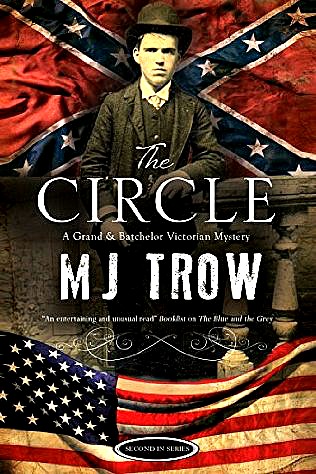
The Circle by M.J. Trow

First Sentence:  At first, he didn’t want to go near the window.   
      
Matthew Grand, former U.S. Army officer, and his business partner James Batchelor, former reporter for the London Tribune, are now enquiry agents in London.   When Matthew’s cousin Luther, commissions them to investigate the suspicious death of Lafayette Baker, Head of the US National Detective Police, they are off to Washington, D.C., Philadelphia, and Knoxville in search of Baker’s killer.  Among the many suspects are those very high-up in the new, post-Lincoln government. 
      
We begin with a betrayal and a hanging.  That captures one’s attention, but it’s then followed by an abrupt transition, which is a bit disconcerting.  However, don’t give up.  There’s a whole lot of good writing and story ahead.
      
One thing Trow does extremely well is to set the scene—“The door swung open and a waft of incense, sickly and powerful, hit them like a wall.  A single lamp burned on a circular table and someone sat behind it, playing solitaire.  His hands were smooth and supple, snaking over the Devil’s picture books with accustomed ease.  His face was n darkness.”  There were, however, terms one might night know, especially for items of clothing, such as a “wide awake” and an “Ulster,” but that’s part of the allure for reading historicals. 
      
Trow has a wonderful way of treating historical figures, such as Edwin Stanton and Sojourner Truth, incorporating them seamlessly into the story while combining them with the fictional characters, such as Grand’s former fiancée and her husband.  The last two enable a nice subplot, as Arlette believes her husband is trying to poison her.  One does love Grand’s description of General Custer—“He remembered Autie Custer from West Point, and a one over-promoted idiot never walked God’s earth.”
      
Grand, the Yankee, and Batchelor are a very good, interesting team.  Their strengths complement one another.  Their different personalities provide some lightness to the story.
      
It is also interesting to see Washington, D.C. during this period. There is a lot of history here that won’t be found in history books about the politics of this country after the war, the beginning of the Klu Klux Klan and the Knights of the Golden Circle. 
      
The Circle” is a fascinating and very well plotted combination of mystery and post-Civil War history. It keeps one engrossed, and guessing, with an excellent building of suspense and plenty of plot twists.  One really does want to know what’s next for this very interesting pair.

THE CIRCLE (Hist Myst-Grant and Batchelor-England/Washington D.C.-1868) – G+
      Trow, M.J. – 2nd in series
      Severn House, 2016

Tuesday, May 3, 2016

Dark Chamber by Jeri Westerson

First Sentence:  It is a sore thing to be an apprentice in King Richard’s London to a former traitor, but it is also the proudest thing I have ever done.
      
Apprentice Jack Tucker tells the story of a lost carcanet (necklace), a dead merchant’s wife, and a locked room.
      
Now and then, one wants a wee bit of a story; a literary amuse-bouche, to fill that space before going to sleep.  But one also wants it to be well-written and leave one with a sense of time well spent.  Look no further.
      
Jack Tucker, former street urchin and pickpocket, is now the apprentice to Crispen Guest, a disgraced knight.  Guest has earned a reputation as the “Tracker,” a finder of lost things.  The relationship between the two grows over time, yet this is still fairly early in the series.

The story is delightful that, in that Jack is the first-person narrator.  In addition to Crispin teaching Jack about investigation, he is also helping him better himself by correcting his grammar--"I didn't like messing about near poisons.  I found m'self drawing my arms in so as to not to touch anything.  'But sir, she didn't drink naught."  "She didn't drink 'anything'," he corrected."-- and giving him an increased perspective on life in general.  Both are wonderful characters.  The interaction between them is extremely well done.  
      
Dark Chamber” is a very clever, very good locked-room mystery with all the right elements.  It is also part of an extremely well-done series.  Enjoy.

DARK CHAMBER (Hist Mys/SS-Crispen Guest-England-Medieval/1388) – VG
Old London Press, 2016

Sunday, May 1, 2016

Quiet Neighbors by Catriona McPherson

First Sentence:  It was the last thing on her mind when she fled across London. 
      
Escaping from her life, Jude returns to a small village she’d visited before.  As a cataloguer, she is drawn to the bookshop there and the kind owner who takes her under his wing, giving her refuge and a job.  Their partnership grows, as does the household, and Jude moves to the gravedigger’s cottage where the neighbors are quiet and the books have their own stories to tell.  But even the residents of the graves are beyond writing threatening notes.
      
Ah, the description of a booklover’s dream—“Books.  Wavering, tottering piles of books.  Brick-stacked towers of books.  Woven dykes and leaning sires and threatening landslides of books.”  And, as we’re talking about books, one has to love an author who entices the reader to look up unfamiliar words.  Plus, who amongst us hasn’t thought of running away from it all at times—“Suddenly she was living in a Anne Tyler novel.  A world where you can set down one life, walk away, and pick up another.”  McPherson paints a picture whereby that seems a perfectly logical action for Jude.
      
The story has an absolutely delightfully enigmatic plot.  One really has no idea where the path is going, but neither is one remotely likely to step off it.  There are wonderful small literary and film references sprinkled throughout—“Do whistle if you come across anything called ‘Love's Labour’s Won,’ won’t you?”
      
There is such an interesting group of characters—unreliable voices, all—but each delightful and appealing in their own way.  There are three generations of characters; Lowell, the older bookshop owner; Jude, and young Eddy in her 20s.  Not only does that add interest and layers to the plot, but to the dialogue—“We shall leave you in peace to continue your…” Lowell stopped talking and stared at her.”  What did you say when I arrived?  “he asked.  “Communing with the spirits of the dead?”  “Interleaved ephemera,” Jude began.  The were words to make ninety-nine out of a hundred listeners glaze over—Eddy snorted like a hog with hay fever—but Lowell was the hundredth, and his eyes lit up.”  One can’t but help to come to love Eddy.  Some of her expressions can make one laugh in the midst of a tense moment.
      
There is a lovely build up of something mysterious, and a well done revelation.  However, a couple of completely unnecessary and annoying portents completely drop one out of the story and also dropped down my rating.  Does the author really not trust that since we’ve read this far, we’ll continue to the end? 
      
In the end, “Quiet Neighbors” leaves us with all the questions answered, all the mysteries solved, and at peace with this lovely group and small Scottish village.  For what more could one wish?

QUIET NEIGHBORS (Myst-Jude-Scotland-Contemp) – VG
McPherson, Catriona – Standalone
Midnight Ink, 2016