Tuesday, March 23, 2021

Black Coral by Andrew Mayne

 First Sentence:  Everyone is looking at me funny.

      The Underwater Investigation Unit is called out to a submerged van at Pond 65.  The passenger has been recovered; but Detective Sloan McPherson, the team's top diver, needs to recover the driver. Rather than one, she finds three bodies in the van, and evidence of a fifth person having been involved.  The investigation puts McPherson and the UIU on the trail of the serial killer, while also trying to catch a thief stealing millions of electronic equipment off mega-yachts. 

      Mayne has a great voice layered with wry humor—"If you have any questions, please contact us through our website," George concludes." … "We have a website?" I ask in a whisper."  He is a true storyteller who creates wonderful characters that play into one another.  One wants to share passages of his writing with others.  Not every male author writes women well.  Mayne is one who truly does, and it is a pleasure to read. 

      Sloan is fully dimensional.   There is a nice injection of the character's personal life which adds balance to the story, injecting light into the dark. There is realism in admitting no one is a perfect parent.  one provides compelling She is introspective both about the case—"I see two different men in front of me.  One is the monster.  The other is the victim.  The victim didn't make the monster, but it sure did nurture him.", and her life as a cop—"…where do I go from here?  Catching the New River Bandits was a good thing, but in no way deeply fulfilling."

      Having Sloan as an archeologist, as well as a diver and cop, brings dimension to the character and opens interesting doors.  The plot is very well done and filled with surprises, yet none of them feel contrived.  The things one learns are unusual.  

      Periodic references to events from the first book, don't distract from the current story, nor does the crossover reference to Mayne's Theo Cray series.  This book stands nicely on its own merit.

      Of the two cases, one is fairly straightforward, but the second takes one down a surprising, twisty path with some definite "Oh, my" moments. Although the main plot is about a serial killer, the book is far more suspenseful than gory.

      BLACK CORAL is an excellent read full of humor, suspense, wicked good twists, and a very unexpected ending. 

BLACK CORAL (PolProc-Det. Sloan McPherson-Florida-Contemp) - Ex
Mayne, Andrew – 2nd in series
Thomas & Mercer, Feb 2021, 317 pp 

Wednesday, March 17, 2021

Final Out by Sheldon Siegel

       First Sentence:  The Honorable Robert J. Stumpf, Jr. scanned the empty gallery in his airless courtroom on the second floor of San Francisco's crumbling Hall of Justice.

       Jaylen Jenkins is arrested for the murder of prominent San Francisco sports agent Robert Blum.   He is on video holding a baseball bat walking toward Blum, and then running away without the bat.  Jenkins claims he is innocent.  But is he?  Without contradictory evidence, can attorney Mike Daley and the team of the San Francisco Public Defender's Office use the "SODDI" defense to convince the jury that some other dude did it? 

       The story begins with a soft case to introduce the principal characters in a casual, conversational manner. In little time, one is taken into the meat of the story and a case that couldn't be more timely.  One of the benefits is learning something new.  Siegel walks readers through every aspect of the case allowing one to experience exactly what is involved.   He educates without lecturing or slowing down the plot.  After all, who else is familiar with the legal term "wobbler"?  It is impossible to conceive the feeling of knowing one is innocent while being told accepting a plea sentence of eight years is a "good deal," yet that happens to so many.

       Through the principal character, Mike, an ex-priest turned lawyer, Siegel created an excellent ensemble cast of Mike's family and friends. They are wonderfully drawn; brought to life mainly through his skill with dialogue.  Even Mike's internal monologues add dimension to the character and the story.   One appealing aspect of the character is his realism.  This isn't a strutting, overly-confident lawyer, this is one who recognizes he could lose his case.

       Set in the San Francisco Bay Area, captured in perfect detail, Siegel brings the region into focus.  It is always fun having a book set in one's hometown, being familiar with the places visited by the characters.  It is even more amusing when the author's description of a particular building echoes one's own thoughts—"The Salesforce Tower dominated the San Francisco skyline and dwarfed the Transamerica Pyramid.  It's impressive in its size and technology, but it looks like an enlarged phallic symbol to me."

       Siegel's style is one of short, tightly written chapters that read almost as vignettes.  Each chapter compels one to continue reading straight through to the end. 

       FINAL OUT is well written and completely involving.  The underlying theme is a sad, but important truth about our justice system. 

FINAL OUT (LegalMyst-Mike Daley-San Francisco-Contempt) – Ex
Siegel, Sheldon – 12th in series
Sheldon M. Siegel, Inc., Jan 2021, 303 pp 

Sunday, March 14, 2021

Huntress Moon by Alexandria Sokoloff

First Sentence:  FBI Special Agent Matthew Roarke is closing in on a bust of a major criminal organization in San Francisco when he witnesses an undercover member of his team killed right in front of him on a busy street, an accident Roarke can't believe is coincidental.

Waiting for his undercover agent to cross a busy street, Agent Matthew Roarke's attention is captured by a woman standing behind the agent.  Moments later, the agent is dead and the woman has disappeared.  As he tracks the woman, he discovers several deaths at which she was present. Is she that most rare of killers: a female serial killer? She is canny, and always one step ahead leaving bodies behind as Roake begins to piece together her motive and her objective.

What an intriguing book, and one where readers are kept off-guard from start to end. It's also a hard book to review without spoilers. Matthew Roarke is a driven character who we come to know in small bits. He is intuitive, yet logical; a perfect balance for someone in his job. But it's the female character who keeps us going. Initially, we don't know the identity of the killer until the "ah-ha" moment, and the tension builds from there.

Information on the main characters is provided in bits as the story progresses.  It is that information that then provides a motive for their actions.  Damien Epps, Roarke's second, is the breath of fresh air.

That the story is told in days heightens the suspense.  The story alternatives between Roarke and the woman, and it works.  The introduction of a man and his 14-year-old child raises the stakes even higher.  The author has an ability not only to set the scene, but to convey the underlying emotions of it—"He steps through the open doorway, past the carved wooden door, into the entry hall with its white painted brick walls and tiled floor. … The terror has turned every cell in his body to ice; his feet can barely move him forward."  

Just as Sokoloff has not given the investigators anything definite they can track, she leaves the reader directionless.  It is clear the moon has significance, but what is unknown.  However, evil, the sense of it, is a prevalent and effective theme.

As the story progresses, the killer takes on the identity first as "Huntress," and finally her name and background are revealed with a powerful twist.  The author's skill is clear in the killer's progression. I don't recall another author being able to transition one's attitude toward a killer in the way Sokoloff does.

This is not a perfect book. There are some plot holes and weaknesses such as the description of the Tenderloin, which is not nearly as grim as portrayed.  The primary thing which did not ring true is Roarke, an FBI Agent, seemingly surprised by the idea of a female serial killer. He just couldn't be that naïve. Another slight miss was the inference of a supernatural element that was not developed. 

HUNTRESS MOON, the first in the series, is rather the first chapter in one long book with an arching theme: Evil. It is a page-turner and truly a popcorn book in that no one will be able to read just one. If you like the first, chances are you will want to continue.

HUNTRESS MOON (PolProc-Agent Matthew Roarke-WestCoast-Contemp) – VG+
Sokoloff, Alexandria – 1st in series
Thomas & Mercer, Jan 2015, 386 pp

Wednesday, March 10, 2021

A Fatal Lie by Charles Todd


First Sentence: On his sixth birthday, Roddy MacNabb was given a fishing pole by his pa, with promises to teach him how to use it.

Scotland Yard Inspector Ian Rutledge is sent to Northern Wales where a man's body was pulled from the River Dee by a young boy. It's first thought the man had fallen from the viaduct that spans high above the river, put there are no signs of a fall, no identification on the body, and no one claims to know him. Only a few clues lead Rutledge on a trail to identify the victim, recreate the man's recent travels, and uncover both the motive and the person responsible for the man's death, and those that follow.

Authors strive to create a good "hook," the opening which will compel the reader to keep turning the pages. Todd's opening does that very effectively.

Ian is a unique character. Shell shock; i.e., PTSD, from WWI has left him with the voice of Hamish, a soldier executed for desertion, in his head. We are reminded of the cost of war, not only in the number of the dead, but the lasting impact on the veterans and their families—"A fine soldier, liked by his men, he didn't suffer, and we must be proud of him, for he gave his life for his King and Country. That isn't terribly reassuring, is it?"

It is always fascinating to read about the forensics of the time. Todd weaves details of places, such as the operations of the aqueduct, and history, the Bantam Battalions, smoothly into the story. These create strong visual images and play into the fact that in the days before technology, police work was done by pulling the thread of clues, a lot of travel, and intuition.

One does need to keep track of who is where. Between the character names and Ian traveling from place to place, and back again, it can become confusing. Pulling up a map proves helpful. It is also a challenge to follow the timeline. There is a lack of clarity as to when things happened as there can be the impression of something happening in the past only to realize it is in the recent past. Follow the trail of bodies which are always one step in front of Ian. Yet it seems to take a while before any real progress is made and then, after all the to-ing and fro-ing, there is the great and complete confession. Good grief.

"A Fatal Lie" is a good book, but not as good as usual. The dialogue was weak, the usual wry humor was completely lacking, and the book could have used some serious editing and simplifying. One wonders whether because of COVID, the authors had little to do but write, so they just kept putting things in. Here's hoping for a crisper, more involving book #24.

A FATAL LIE (HistMys-Ian Rutledge-England-1921) - Okay
Todd, Charles – 23rd in series
William Morrow, 349 pp – Feb 2021

Sunday, January 3, 2021

My Favorite Reads of 2020

I don't think there has been a year when I read so few books as COVID-19 destroyed my attention span almost completely.  That said, there were a number of books that stood out to me this year.  ENJOY!

Ann Cleeves - FROZEN
Charles Finch - THE LAST PASSENGER
C.S. Harris - WHO SPEAKS FOR THE DAMNED
Louise Penny - ALL THE DEVILS ARE HERE
Dana Stabenow - NO FIXED LINE

There is also my group of HONORABLE MENTIONS; books I found close to excellent, but with one or two quibbles.  They are:

C.J. Box - LONG RANGE
Jack Fredrickson - THE BLACK CAGE
Craig Johnson - NEXT TO LAST STAND
Donna Leon - TRACE ELEMENTS
J.D. Robb - SHADOWS IN DEATH
Michael Robotham - WHEN SHE WAS GOOD
Sheldon M. Siegel - THE DREAMER
Will Thomas - LETHAL PURSUIT
Jeri Westerson - SPITEFUL BONES

Happy Reading,
LJ

Thursday, December 31, 2020

Who Speaks for the Damned by C.S. Harris

First Sentence: Alone and trying desperately not to be afraid, the child wandered the narrow, winding paths of the tea gardens.

Nicholas Hayes, a son to the late Earl of Seaford, had been convicted of murder, transported to Botany Bay, and assumed dead. Instead, he returned to London and was murdered. An Asian child who had been with Hayes, finds the body and goes to Hayes' former friend James Calhoun, valet to St. Cyr. After which, the child disappears. It is now up to St. Cyr to find the child and uncover the murderer.

There is nothing better than a book that captivates your attention from the very beginning. One is introduced to several of the main and recurring characters, learns about their backgrounds, and is taken straight into the story.

Harris sets the story up beautifully, providing multiple motives and suspects. Nothing here is obvious. She also effectively conveys the fear felt by young Jai, alone in a foreign country. He is a character who touches the heart but also allows for an interesting look at China during this period. The historical information woven into the story is both informative and harshly factual. Harris makes no attempt to soften the image of this time and confirms that bigotry has always existed.

Honorable characters have great appeal. When asked why Sebastian, a Viscount, after all, spends his time chasing murders, especially when the victims are despicable characters themselves, he responds: "Making certain a killer doesn't get away with what he has done is an obligation we the living owe to the dead—no matter how unsavory we consider them to be." ... "Am I not my brother's keeper?" …"And because I believe we are all connected, every living thing one to the other, so that I owe to each what I would owe to myself." What a perfect definition of equal justice under the law.

The relationship between Devlin and his wife Hero is so well done. The intimacy is neither gratuitous nor salacious, and dialogue is very natural. Harris does involve Hero in the investigation, but in a way that makes sense for a woman of her time and rank.

The story is well-plotted. It moves along at a good pace and presents twists at just the right points although one might wish authors weren't quite so predictable in their timing. That said, it is nice when one is surprised by a plot twist. The story grows with one revelation upon another. Rather than confusing, this adds to the intrigue of the story. The inclusion of information on the forensics of the time adds veracity and interest.

Good dialogue makes all the difference, particularly when twinged with humor—"How precisely does one go about accosting a man in the middle of a ball in order to discuss the murder of someone who once ran off with his wife." "I don't know," said Sebastian. "But I'll think of something."

"Who Speaks for the Damned" is an excellent read. The mystery is solved with an ending that speaks to humanity and puts paid to all the ugliness caused by man. It draws one in from the start and keeps one engaged to the very end.

WHO SPEAKS FOR THE DAMMED (HistMys-Sebastian St. Cyr-London-1814) – Ex
Harris, C.S. – 15th in series
Berkeley – Apr 2020

Tuesday, October 27, 2020

Frozen by Ann Cleeves

First Sentence:  Vera woke to a free day and an unexpected longing for exercise.

It's her day off and DI Vera Stanhope takes the opportunity to visit a new bookshop located in a renovated chapel. What she was not looking for was a skeleton unearthed in a cellar baptismal font.  Time for Vera to solve this long-cold case.

Cleeves' descriptions allow one to see places we've not been, in the present and the past—"Standing with her back to old stones, she imagined squads of legionnaires marching… they must have policed the region then, so she saw them as her forbears, as kindred spirits, and felt a connection across the centuries."  Bringing us to the present, she carries forth that sense of timelessness with her wonderful imagery—"the building that had once been built to the glory of God, now celebrated the story in all its forms." Whereupon the mood is effectively broken and the investigation begins.

Even though the books are separate from the television series, those who watch may clearly hear the voice of actress Brenda Blethyn as Vera.  Rather than a negative, it adds a warmth and personal touch to the story. Still, this is not Vera's story alone, but one which includes her team, including Joe who is still her second in the books, and Holly in a scene that makes one smile. However, if one is looking for in-depth descriptions of the characters, or quantities of backstory, it's not here.  This is a short story, after all.

What is here is atmosphere and Cleeve's creative use of the weather almost as another character.  Nothing is lost in the construction of this fascinating short story.  Suspects are identified, clues tracked down with twists and red herrings.

"Frozen" may be a fairly simple story, but it is well-crafted and, if one has not previously read Ann Cleeves, this a perfect introduction to her writing and the Vera series.

FROZEN (PolProc/SS-DI Vera Stanhope-England-Contmep) – VG+
Cleeves, Ann – Short Story – 8.5 in series
Minotaur Books, Sept 2020

Tuesday, October 20, 2020

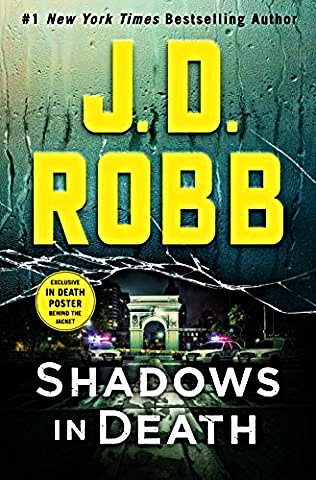
Shadows in Death by J. D. Robb

First Sentence:  As it often did since he'd married a cop, murder interrupted more pleasant activities. 

Lt. Eve Dallas, by her husband, Roarke, goes to the scene of a murdered woman.  While on-site, Roarke sees a man he knew from his past in Ireland. Lorcan Cobbe, a contract killer, claims he is Roarke's father's actual and first son. He hates Roarke enough to kill him, and everyone he loves.  Eve is certain the dead woman's husband hired Cobbe to perform the hit and commits to proving it first, then stopping Cobbe, as more bodies turn up.

There are times when one wants an entertaining, captivating read.  With her 51st book in the Eve Dallas series, Robb succeeds in creating exactly that.  Yes, the plots are somewhat predictable, but the world Robb has created is visual, and the characters are ones about whom readers care.

What is remarkable is that the series began in 1995 with the first book set in 2058 and Eve being 30 years old, releasing two Dallas books/year, plus the occasional novella.  Now the series is in 2061; three years and 51+/- cases later, bringing Eve's clearance rate to ~17 cases per year, or once every three weeks.  What police department wouldn't love that?

Robb has a deft hand when it comes to dialogue, even creating slang that fits for the near-future time period.  How clever to use an expression known to readers in the present but would be anachronistic to the period.  There are some great lines, and her wry humor is always a pleasure.  A discussion on the subtle differences between colors leads to an internal observation—"Peabody turned a little green—perhaps celadon—and turned her head to stare hard at the wall." Robb carries thoughts through from one scene to another with great deliberateness and ease.

One learns more about Roarke's childhood and one must respect that Robb, even this far into the series, still has new information to impart. One small irritant is Roark's references to Eve being "his," making her seem a possession. However, this is mitigated by the realization that Eve claims Roarke in the same manner and showing it is a manifestation of their commitment of care and protection, and not possessiveness, even including those around them.  Yes, the scenes of lovemaking are hot, but they are more about emotion than sex.

Eve is not perfect which makes her more real.  She has areas of discomfort and gaps in her knowledge for anything beyond her job or her city—"They look like cops…I need them to look like farmers. Irish farmers," Eve added. "Who are out there doing farm stuff."

There is an urgency and intensity to the investigation which gives the sense of needing to run to keep up. The action scenes are visceral, tense, exciting, and filled with twists. They provide excellent examples of Eve's leadership and authority, and the respect she has earned. Even so, it is not a perfect book.  There were opportunities for danger and suspense not taken, and the ending seemed too quick with a final scene a bit silly, albeit satisfying. 

"Shadows in Death" is an excellent remedy to offset the stress and uncertainty of these times in which we live.

SHADOWS IN DEATH (PolProc-Eve Dallas, Future NYC, 2061) – VG
Robb, J.D. – 51st book in series
St. Martin's Press – Sept 2020


Tuesday, October 13, 2020

Spiteful Bones by Jeri Westerson

First Sentence:  Nigellus Cobmartin stood in the courtyard of his family home – its garden walls crumbling, its arched windows overlooking the tired and weedy garden with its dead flowers and gnarled trees – and sighed.

Crispin Guest's house is filled with his assistant Jack, his wife Isabel, and their many children, as well as the satisfaction of watching grow and providing training for Christopher Walcote, the son he can never acknowledge.  Into that tranquility comes John Rykener/Eleanor Cobmartin with an urgent summons.  In restoring the home he inherited, John's "husband's" workers uncover a body holding a precious relic. The body had been bound and sealed within a wall for 20 years.  It is up to Crispin to discover the killer while protecting the secret of John's true identity.

One can only appreciate when authors, particularly of historical mysteries, provide a section of "Notes About Characters," as well as a "Glossary."  The sections are not only helpful but interesting in themselves.

No one stays the same age forever.  Having characters who age, and whose life circumstances change, adds realism to the story, and much has changed for Westerson's characters.  Readers of the series will appreciate that, but even new readers are given a sense of how time has progressed.

Westerson has a wonderful voice.  Her dialogue is reflective of the period without being mired in it.  She writes with a balance of humor and drama.  It is interesting to see how, even in this period, forensic evidence was taken into account—"But it looks as if someone coshed him good.  Aye, look at the wood of the uprights here.  If he was still awake, there would have been scratches and scuffs from a struggle."  One issue, however, is the frequent use of Latin phrases.  While is it very appropriate to the period, an immediate translation of each phrase, as is often done by other authors, would not have been amiss.  Still, there are lines which make one smile—"Sometimes, Jack, the Church, in all its wisdom, is lacking when it comes to compassion."

The relationships are enjoyable and add dimension yet don't overtake the plot.  They provide richness and emotion.  One becomes attached to the characters. There are times where one might question whether Crispin is too modern; too good, too noble.  Yet, it is part of the development one has seen in the character and is part of what draws one back to the series.

"Spiteful Bones" presents an effective twist and an exciting climax.  Historical mystery devotees will be pleased.

SPITEFUL BONES (Hist Mys-Crispen Guest-London-1398) – G+
Westerson, Jeri – 14th in series
Severn House – Sept 2020