Thursday, September 12, 2013

The Hangman by Louise Penny

First Sentence: Armand Gamache didn’t like what he was looking at, but then, few people would.

A guest at the Inn and Spa in Three Pines is found hanged by a jogger. Inspector Armand Gamache and his deputy Jean-Guy Beauvoir are sent to investigate. The question is whether this is a suicide or murder.

This novella was written for Canada’s Literacy Project at the Grade 3 level for adult readers. The style and plot are very simple and, where characters in the series books, would use French words or phrases, English is used here. Even so, this is a wonderfully written story.

The underlying question is “why?”. Why was the man there? Whether by his own hand or that of another, why did he die? There is another question of “why” but I refuse to give away a major plot point.

This is yet another example of Ms. Penny’s skill and quality of storytelling even for those of us way above Grade 3 level reading. Do not, however, confuse that for meaning the story has been ‘dumbed-down’. Not at all. It has all the elements that define an excellent tale with its strong sense of place, excellent characters, wonderfully done and natural dialogue. Although the structure and language may be fairly simple, the plot twist is not and the motive leaves us thinking.

The Hangman” is complete unto itself and a wonderful read, no matter your age or reading level.

THE HANGMAN (Pol Proc-CI Armand Gamache-Canada-Contemp) – Ex
Penny, Louise – Short Story
Grass Roots Press – 2010

Tuesday, September 10, 2013

How the Light Gets In by Louise Penny

First Sentence:  Pandora was still pretty.
   
A suspected suicide is found at the base of the Champlain Bridge.  Chief Inspector Armand Gamache is still dealing with the forces at the highest level of the Sûreté du Québec set on destroying his career.  He is without his college and friend Jean-Guy Beauvoir, yet determined to learn what is the motive.  A trip to Three Pines is prompted when Gamache receives a call of Myrna, owner of the used bookstore.  An acquaintance of hers had visited and was due back for Christmas but hadn’t returned or been heard from.   These three seemingly disparate threads come to be one of Gamache’s most dangerous cases of his life.
   
It is not easy to describe the images that go through the mind of a phobic, yet Ms. Penny does and does it brilliantly.  That is just the beginning of another book by this incomparable author.  There are some who mistakenly classify Ms. Penny’s books as “cozies.”  They are not.  They are multi-layered character studies.  Even though set in the seemingly idyllic town of Three Pines, her stories reinforce the fact that darkness can intrude anywhere. 
   
Penny’s characters are wonderful.  They are not perfect people but ones which are very human, with strengths, weaknesses, faults, and enormous depths.  Ruth is a literary treasure.  Gamache is a man of integrity and principle; someone to be admired and exemplified yet with blind spots of his own.   The town of Three Pines is a character onto itself.  It may be imaginary, yet the town and its residents, are brought to life. 
   
Her descriptions are evocative…”But this was the snow of her childhood.  Joyful, playful, bright and clean.  The more the merrier.  It was a toy.”  At the same time, there is a sense of plaintiveness here as well…”Why do decent young men and women become bullies?  Why do soldiers dream of being heroes but end up abusing prisoners and shooting civilians?...Because everyone else does…Corruption and brutality is modeled and expected and rewarded.”  That’s only one example of Ms. Penny’s voice and superb dialogue.  She is one of those rare authors whose writing often compels you to read it aloud to others, both because of its excellence and its message. Why do I quote so much of her work?  How could I even begin to express things as perfectly? 
   
The multi-threaded plot has a complexity that gives real depth to the story.  There were a couple instances where I thought I’d caught an inconsistency or wondered whether something could have been done another way, only to realize one should always trust Ms. Penny as her choices are the exact right ones.  There are unexpected, powerful twists, but never done in a way that seems manipulative.  At times, the protagonist is as surprised as the reader.  There is tension, drama and tremendous suspense. 

Ms. Penny, in an interview for the television series, made reference to..."these books are love letters to where I live, to the village I live in, to the people I live with..."  I don't think she realized how much they would also become love letters to those of us who love her books.
   
How the Light Gets In” is an excellent story of contrasts and the question of good overcoming evil; of light and darkness.   This may be Ms. Penny’s best book yet, although we’re talking in minute comparisons of excellence from her previous books.  However, this is not where a new reader should start the series.  Although each book could stand on its own, the entire series should really be considered as a whole and begun at the first book. 

HOW THE LIGHT GETS IN (Pol Proc-CI Armand Gamache-Canada-Contemp) - Ex
Penny, Louise - 9th in series
Minotaur Books, 2011


Friday, August 30, 2013

Blind Justice by Anne Perry

First Sentence:  Hester let the hansom cab pass, then crossed Portpool Lane and went in through the door to the clinic for sick and injured prostitutes.
       
When one of the workers Hester Monk's women's shelter is concerned that her father has been the victim of an unscrupulous pastor, she asks for Hester's help.   In time, the case is brought to court with Oliver Rathborn, newly raised to being a judge,  to preside.  No one could have anticipated the devastation such a case could cause to all their lives.

From the very beginning, we are introduced to the main characters, as well as being provided their backstories.  While this may not be strictly necessary for continuing readers, it is a boon for readers new to the series and an author who doesn’t take forget new readers is one to be commended. Perry has wonderful ability for conveying insights into the lives of her characters and their thoughts.  They become very real people to the reader; people about whom you care.  In this book, that is particularly important.

Ms. Perry excels at raising social, moral and ethical issues and looking at them from various sides.  She poses questions and, while she may provide her answers, she causes the reader to consider and weigh their own answers.  She even address crime by those who feel they are entitled…”…they all think they will be the one to get away with it.”   Although this introspection does slow the first part of the book, she more than makes up for that later.   

Perry creates a very strong sense of time and societal conventions, yet often in subtle ways.  A character is admiring a particular painting…”it is quite lovely,” he said instead, looking at the little painting.  “I think he could well become professional, don’t you?”  Henry smiled.  “Actually it’s a ‘she,’ so I doubt it…”

There is nothing fluffy about a Perry book.  She asks serious questions, addresses serious issues, and makes you look at things in a way you may not have previously.  Although set in Victorian England, all the issues she raises are just as relevant today.  At the same time, the story has an excellent twist, plenty of suspense, drama and tension.

Blind Justice” may be a bit of a morality play, but it’s also a cracking good and suspenseful mystery.  Although a bit slow and repetitive in the beginning, one should always trust that Ms. Perry will make it well worth your while to stay with it and read to the end.  You won’t regret it.

BLIND JUSTICE (Hist Mys-Monk/Hester/Oliver Rathbone-England-Victorian) - VG+
Perry, Anne - 19th in series
Ballentine Books - 2013


Death in the Vines by M.L. Longworth

First Sentence:  Olivier Bonnard sat on the bottom stone step of his cellar, his hands gathered around his head as if he were attempting to soothe a migraine.
      
Winery owner Olivier Bonnard discovers some, but not all, of his rare vintage wines have been stolen from his cellar.  Gilles d’Arras is missing something even more critical, his wife, Pauline, has disappeared.  It is up to Magistrate Antoine Verlaque and Police Commissioner Bruno Paulik to solve both mysteries.
      
For anyone who loves wine, the opening is quite devastating.  Unfortunately, it also contains a completely unnecessary portent.
       
Commissioner Paulik and Magistrate Verlaque are characters who are very different from one another, but work very well together, which is refreshing.  I did enjoy how the families of the characters played into the story.  It confirms the setting being a small city rather than being in Paris.  However, there was very little character development and much of the focus was on personal relationships, rather than the crimes.  That said, there were interesting insights into relationships in general.  Aside from the principals, there were a lot of characters introduced but with no indication of who they were or how they were relevant.
      
Although a strong sense of place is lacking, there are enough passages with visual descriptions that paint verbal pictures and assure us that we are in the beautiful area of Aix-en-Provence.  There are wonderful descriptions of wine, but not the mouth-watering descriptions of food other authors may provide. The narrative is smooth and the dialogue natural.
       
“Death in the Vines” is a gentle mystery.  It is much more a story of character—and very good, interesting characters they are--than of plot.  It is enjoyable but not terribly exciting. 


DEATH IN THE VINES (Pol Proc-Verlaque/Paulik-France-Contemp) - Good
Longworth, M.L. - 3rd in series
Penguin Books - 2013


Friday, August 23, 2013

Holy Orders by Benjamin Black

First Sentence:  At first they thought it was the body of a child.

A naked body, so badly beaten as to be almost unrecognizable, is found in the body of the canal, bringing out Inspector Hackett and ending up on a table in pathologist Quirke’s morgue.  Surprisingly, Quirke knows the victim, reporter Jimmy Minor, to be a friend of his daughter, Phoebe.  Phoebe feels she is being followed and learns it is the victim’s sister, Sally.  Together, Phoebe and Sally ask for Quirke’s help in learning who killed Jimmy.
     
We start out being introduced to a collection of characters who, after Chapter One and with the exception of Inspector Hackett, disappear and are never seen again.  From there, we move to a new set of characters whose common trait seems to be angst and depression.  I can forgive quite a bit, when it comes to characters, but there has to be something appealing about them beyond watching them self-destruct.  Although Hackett was the most appealing character, he was also the one of whom we saw the least. 
     
Other than the obsession over rain, there was little sense of time or place.  It really could have been set anywhere in the British Isles except that the glumness of the characters, the alcohol, obsession with the Church, referring to the Guards (Police) and, yes, the rain, gave it away as Ireland but only if you thought about it.
     
Beyond that, we had a detective who did little detection, a pathologist who did not pathology, depressing characters and very little suspense.  Lost in all this was the mystery which only popped up occasionally when the characters weren’t busy obsessing over their lives.  The only part worth slogging all the way through the book for was a scene at the end.  Even the satisfaction of that, however, was mitigated by the unsurprising events in the aftermath.

"Holy Orders" was definitely not my glass of Jameson.   I did keep thinking the book was "very Irish," if your definition of Irish is relentlessly bleak settings and depressing characters,.  For me, however, that alone does not a good book make.  I read the first of Black's Quirke books when it first came out, but none since.  Now I remember why.
     
HOLY ORDERS (Myst-Quirke-Ireland-1950s) – Poor
Black, Benjamin – 6th in series
Henry Holt & Company, 2013


A Spider in the Cup by Barbara Cleverly

First Sentence:  On a neglected reach of the Thames, a woman stood counting the chimes ringing out from Chelsea Old Church behind her.          
       
The body of a young woman buried in the banks of the Thames is discovered.  What attracted the dowsing rods this amateur group member’s attention, was the priceless gold coin in her mouth.  That she is also missing a toe sends the case to the desk of Assistant Commissioner Joe Sandilands.  Sandilands, however, is also task with protecting an important US Senator who is in London for an historic global economic conference.  Senator Cornelius Kingstone’s own bodyguard from the F.B.I., used to report to Sandilands in the British Army.  Protecting Kingstone, Joe learns there is much, much more at risk than one Senator’s life.

It is always painful to write a negative review for a book by an author whose previous works one has loved.  Sadly, there is just no way around it, in this case. 
      
Ms. Cleverly has such a wonderful ability to paint verbal pictures.  “The amber glow of the gas mantles was beginning to fade to lemon as a brightening sky quenched them, offering her sensitive eyes a symphony in grey and gold worthy of Whistler.”  I did, however, have a problem remembering when, exactly, the book is set.  Although there is substantial, and interesting, historic information included, if your knowledge of the pre-WWII era isn’t strong, it’s not easy to grasp. 
       
The characters are interesting and introduced very well although I was sorry to see those at the beginning of the story disappear so quickly, particularly Hermione Herbert, the head of the dowsers.  She was smart, self-assured, quick-witted and observant.  Another delightful character was Joe’s sister, Lydia, who was bright, capable and definitely not a wimp. For those who’ve not read previous books in the series, Cleverly provides details of the recurring characters backgrounds in a way that is informative yet not boring.  


Cleverly does write very good dialogue sprinkled with wry humor… “Joe’s expression of slight boredom was enlivened by a flash of humor.  “Thank God no one put a bomb in the surprise pudding.  The wealth makers of the world would have been splattered all over London!”  “Strawberries, crème de la crème and blue blood sauce,” Bacchus spoke grimly.  “A real Eton Mess we’d have had to clear up!”
       
One of the things to be appreciated about Ms. Cleverly’s previous books was that they were, at their heart, really good mysteries.  Sadly, that was completely lost in here.  There was a mystery but, by far, the greater focus was on there being an international conspiracy and the book suffered greatly because of it. …“Republicans, Communists, Fascists, Daughters of the Revolution, Seventh Day Adventists…you name it.  Hard to believe but a fully employed population earning a living wage with provision for good health, equal states for coloured folks and immigrants of all races, and equal rights for women come pretty low on the agenda of the wealthy and privileged.”
       
Although this book had many very good attributes, the overwhelming problem for me was at the end.  I don’t know whether Ms. Cleverly has something going on in her life that prevented her for improving this book; or whether she changed or didn’t use an editor; or whether she or her researcher didn’t check the information but the entire premise on which the motive for the story was based takes the book from fiction to absolute alternative reality.  We’re not talk a small thing that can be excused as creative license.  For anyone who knows anything about the structure of the U.S. Government, we’re talking a major point of unalterable fact so egregious it could not be overlooked. 
       
The “Spider in the Cup” came close to being a “wallbanger” for me.  The only thing that saved it was that justice was brought home to the killer.  Here is hoping Ms. Cleverly does much, much better with her next book.


A SPIDER IN THE CUP (Hist Mys-Assistant Commissioner Joe Sandilands-England-1933) – Poor
Cleverly, Barbara - 11th in series
Soho Press, 2013


Thursday, August 8, 2013

A Dark Anatomy by Robin Blake

First Sentence:  According to the case notes, a checked against my private journal, it was on Tuesday the 18th of March, 1740, that a succession of disturbing events ran their course through the life of our tidy Palatinate town of Preston.
       
Coroner Titus Cragg is called to view the body of Dolores Brokletower, wife of the local squire.  The body is moved to the ice house until an autopsy by Cragg’s friend, doctor Luke Fidelis, can be done and then an inquest called. Before that can happen, the body disappears and more deaths occur.  Who is trying to prevent the inquest and why?
       
 I really like Blake’s voice and that the story is told in first person.  While that’s not usually my favorite, it really works here as it helps provide a sense of time; a bit before Jane Austen.  There is even a nod to “Dear Reader” of Charlotte Bronte.  Yes, there is a mild portent, but I was willing to forgive it.
       
There is delightful, natural humor incorporated in the narrative, which adds to the appeal of the protagonist. “I let her [Cragg’s wife] sign of the cross go without comment.  She was always more the papist when she had been with her mother.”  Cragg’s discussions with Fidelis on medicine versus religion, and with his wife on witchcraft, religion and spiritualism are very well done.  They a provide perspective on attitudes and science during that time and the information is well incorporated into the story through both dialogue and the narrative of Cragg. 
       
Blake has created wonderful characters in Cragg, his wife, Elizabeth, his clerk Furzey and friend Fidelis.  These are characters about whom we come to care and want to know more.  What’s nice is that both they, and the less than appealing characters, are fully dimensional and interesting.
       
Blake definitely knows how to create a dramatic moment.  It leads to a startling twist and, thus, a fascinating discussion. 
       
A Dark Anatomy” is filled with wonderful characters, a strong sense of time and place, excellent dialogue and a cracking good plot.  I can’t wait to read his next book, “Dark Waters.”  Highly recommended.  


A DARK ANATOMY (Hist Mys-Titus Cragg/Luke Fidelis-England-1740) – VG+
Blake, Robin – 1st in series
Minotaur Books, 2011


Saturday, July 20, 2013

The Bones of Paris by Laurie R. King

First Sentence:  The envelope reached Bennett Grey early Wednesday afternoon.
       
There’s nothing to equal a powerful opening that contains evocative descriptions which paint mental pictures.  We feel a connection to Bennett, even though we know nothing about him.  King has captivated us and ensured our waiting to follow along, even if it is to a sex-scented bedroom in Paris.
       
Unfortunately, we also soon run into an issue which can be very annoying.  Apparently, there was a prior book with these characters; “Touchstone”.  Without having read the first book, one feels rather lost in understanding the character relationships.  An even greater shortcoming is that neither the back story of the character in the prologue, nor the character himself, appears until much later in this book.  Rather than being intriguing, it starts to leave the reader feeling lost and dissatisfied, particularly as he is one of the most interesting characters of the book and doesn’t reappear until nearly two-thirds of the way into the story.
      
Harris Stuyvesant is the primary narrator of the story and an interesting one.  He is a perfect reflection of the period, yet not someone you always like.  He is a 1920s noir private eye, yet not so tough he is without vulnerability and self doubt.  The relationship between Harris and Grey’s sister Sarah, and the scenes of them together are some of the most powerful of the story.
       
King’s dialogue has the feel of the period.  You can almost hear the narrator of a black and white film from the period…”It’s always a shock, when someone cares more about a thing than you do.”  King adeptly plays with the reader’s psyche.  At the same time, she is very good at conveying the persona of whosoever’s POV controls each section of the story, and at conveying emotion…”The list was, in fact, a ringed notebook bulging with anguish and loss.”.
       
King captures Paris beautifully…”Paris obscured by snow or softened by fog, Paris adrift on fallen blossoms or carpeted in autumn leaves, Paris in the rain, at night, the lights streaking on the pavement….” She creates a very strong sense of place and, as the art and artists of the time--and she does include almost everyone of them who was in Paris during that time--play a significant role to the story, her descriptions may send one to the internet to learn more about the individuals and their art.  This also, however, becomes an issue as some of the narrative sections become so long, the reader may start looking for the actual story wondering where the core of the plot has gone.

I was relieved when we did get back to the story but dismayed when I identified the villain fairly early on.  While the climatic scene was suspenseful and dramatic, it was also a bit over the top with shades of Edgar Allen Poe.
      
The Bones of Paris” has some great strengths but also some painful weaknesses.  It is an interesting book and one I never considered putting down.  Yet, I can’t help but wonder whether a much stronger editor would have solves some of the issues and made it a much better book.  Please, authors, do use and listen to your editors.  It’s unfortunately, as Ms. King is a very good writer and her book “Folly” will always remain as one of my favorites.


THE BONES OF PARIS (Hist Mys/Susp-Harris Stuyvesant-Paris-1929) – Okay
King, Laurie R.
Bantam, 2013


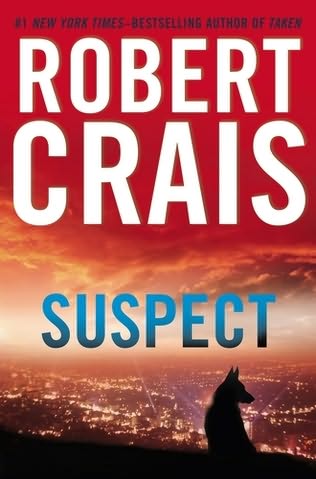
Suspect by Robert Crais

First Sentence: Maggie stared at Pete with rapt, undivided focus.

Maggie is an 85-lb, black and tan German Shepherd trained by the military. When her partner was killed in Afghanistan, Maggie was wounded and sufferes from PTSD. She’s now with the LAPD, but the head of the unit isn’t certain she’ll ever be able to work. Scott James is a policeman who was shot, and whose partner was killed, in a shootout. The LAPD doesn’t really think Scott should return to duty. Now, in spite of everyone’s, and their own, doubts, they are trying to be partners and to find out who killed Scott’s partner, and nearly killed him.

Crais definitely knows how to tell a story. His experience as a screenwriter is evident on every page. He knows how to establish a scene, create characters, and write dialogue with a natural ear and flow.

What sets this book apart, from others he has written, is the use of first-person point-of-view for Maggie, the Shepherd. There is no question Mr. Crais did his research on both dogs in general, and on military and K-9 dogs in particular. What could have come off as cute, definitely does not. It does humanize Maggie, but most of us know dogs (and cats) are nearly human.

I actually had more problems with the character of James in that he came off a bit too macho, aren’t-I-tough at times; a little too stereotypical for me. Still we did see a couple instances of his more vulnerable side, and that helped.

Suspect” is a little predictable, and somewhat formulaic, but it is also a page-turner. It may not be great literature, but it is a darned good read for a weekend or an airplane trip. There’s nothing wrong with that.

SUSPECT (Pol Prod-Scott James/K-9 Maggie-Los Angeles, CA-Contemp) – Good+
Crais, Robert – Standalone
Putnam, 2013