Tuesday, October 27, 2020

Frozen by Ann Cleeves

First Sentence:  Vera woke to a free day and an unexpected longing for exercise.

It's her day off and DI Vera Stanhope takes the opportunity to visit a new bookshop located in a renovated chapel. What she was not looking for was a skeleton unearthed in a cellar baptismal font.  Time for Vera to solve this long-cold case.

Cleeves' descriptions allow one to see places we've not been, in the present and the past—"Standing with her back to old stones, she imagined squads of legionnaires marching… they must have policed the region then, so she saw them as her forbears, as kindred spirits, and felt a connection across the centuries."  Bringing us to the present, she carries forth that sense of timelessness with her wonderful imagery—"the building that had once been built to the glory of God, now celebrated the story in all its forms." Whereupon the mood is effectively broken and the investigation begins.

Even though the books are separate from the television series, those who watch may clearly hear the voice of actress Brenda Blethyn as Vera.  Rather than a negative, it adds a warmth and personal touch to the story. Still, this is not Vera's story alone, but one which includes her team, including Joe who is still her second in the books, and Holly in a scene that makes one smile. However, if one is looking for in-depth descriptions of the characters, or quantities of backstory, it's not here.  This is a short story, after all.

What is here is atmosphere and Cleeve's creative use of the weather almost as another character.  Nothing is lost in the construction of this fascinating short story.  Suspects are identified, clues tracked down with twists and red herrings.

"Frozen" may be a fairly simple story, but it is well-crafted and, if one has not previously read Ann Cleeves, this a perfect introduction to her writing and the Vera series.

FROZEN (PolProc/SS-DI Vera Stanhope-England-Contmep) – VG+
Cleeves, Ann – Short Story – 8.5 in series
Minotaur Books, Sept 2020
Tuesday, October 20, 2020

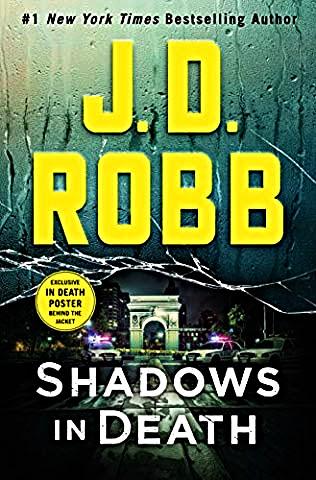
Shadows in Death by J. D. Robb

First Sentence:  As it often did since he'd married a cop, murder interrupted more pleasant activities. 

Lt. Eve Dallas, by her husband, Roarke, goes to the scene of a murdered woman.  While on-site, Roarke sees a man he knew from his past in Ireland. Lorcan Cobbe, a contract killer, claims he is Roarke's father's actual and first son. He hates Roarke enough to kill him, and everyone he loves.  Eve is certain the dead woman's husband hired Cobbe to perform the hit and commits to proving it first, then stopping Cobbe, as more bodies turn up.

There are times when one wants an entertaining, captivating read.  With her 51st book in the Eve Dallas series, Robb succeeds in creating exactly that.  Yes, the plots are somewhat predictable, but the world Robb has created is visual, and the characters are ones about whom readers care.

What is remarkable is that the series began in 1995 with the first book set in 2058 and Eve being 30 years old, releasing two Dallas books/year, plus the occasional novella.  Now the series is in 2061; three years and 51+/- cases later, bringing Eve's clearance rate to ~17 cases per year, or once every three weeks.  What police department wouldn't love that?

Robb has a deft hand when it comes to dialogue, even creating slang that fits for the near-future time period.  How clever to use an expression known to readers in the present but would be anachronistic to the period.  There are some great lines, and her wry humor is always a pleasure.  A discussion on the subtle differences between colors leads to an internal observation—"Peabody turned a little green—perhaps celadon—and turned her head to stare hard at the wall." Robb carries thoughts through from one scene to another with great deliberateness and ease.

One learns more about Roarke's childhood and one must respect that Robb, even this far into the series, still has new information to impart. One small irritant is Roark's references to Eve being "his," making her seem a possession. However, this is mitigated by the realization that Eve claims Roarke in the same manner and showing it is a manifestation of their commitment of care and protection, and not possessiveness, even including those around them.  Yes, the scenes of lovemaking are hot, but they are more about emotion than sex.

Eve is not perfect which makes her more real.  She has areas of discomfort and gaps in her knowledge for anything beyond her job or her city—"They look like cops…I need them to look like farmers. Irish farmers," Eve added. "Who are out there doing farm stuff."

There is an urgency and intensity to the investigation which gives the sense of needing to run to keep up. The action scenes are visceral, tense, exciting, and filled with twists. They provide excellent examples of Eve's leadership and authority, and the respect she has earned. Even so, it is not a perfect book.  There were opportunities for danger and suspense not taken, and the ending seemed too quick with a final scene a bit silly, albeit satisfying. 

"Shadows in Death" is an excellent remedy to offset the stress and uncertainty of these times in which we live.

SHADOWS IN DEATH (PolProc-Eve Dallas, Future NYC, 2061) – VG
Robb, J.D. – 51st book in series
St. Martin's Press – Sept 2020


Tuesday, October 13, 2020

Spiteful Bones by Jeri Westerson

First Sentence:  Nigellus Cobmartin stood in the courtyard of his family home – its garden walls crumbling, its arched windows overlooking the tired and weedy garden with its dead flowers and gnarled trees – and sighed.

Crispin Guest's house is filled with his assistant Jack, his wife Isabel, and their many children, as well as the satisfaction of watching grow and providing training for Christopher Walcote, the son he can never acknowledge.  Into that tranquility comes John Rykener/Eleanor Cobmartin with an urgent summons.  In restoring the home he inherited, John's "husband's" workers uncover a body holding a precious relic. The body had been bound and sealed within a wall for 20 years.  It is up to Crispin to discover the killer while protecting the secret of John's true identity.

One can only appreciate when authors, particularly of historical mysteries, provide a section of "Notes About Characters," as well as a "Glossary."  The sections are not only helpful but interesting in themselves.

No one stays the same age forever.  Having characters who age, and whose life circumstances change, adds realism to the story, and much has changed for Westerson's characters.  Readers of the series will appreciate that, but even new readers are given a sense of how time has progressed.

Westerson has a wonderful voice.  Her dialogue is reflective of the period without being mired in it.  She writes with a balance of humor and drama.  It is interesting to see how, even in this period, forensic evidence was taken into account—"But it looks as if someone coshed him good.  Aye, look at the wood of the uprights here.  If he was still awake, there would have been scratches and scuffs from a struggle."  One issue, however, is the frequent use of Latin phrases.  While is it very appropriate to the period, an immediate translation of each phrase, as is often done by other authors, would not have been amiss.  Still, there are lines which make one smile—"Sometimes, Jack, the Church, in all its wisdom, is lacking when it comes to compassion."

The relationships are enjoyable and add dimension yet don't overtake the plot.  They provide richness and emotion.  One becomes attached to the characters. There are times where one might question whether Crispin is too modern; too good, too noble.  Yet, it is part of the development one has seen in the character and is part of what draws one back to the series.

"Spiteful Bones" presents an effective twist and an exciting climax.  Historical mystery devotees will be pleased.

SPITEFUL BONES (Hist Mys-Crispen Guest-London-1398) – G+
Westerson, Jeri – 14th in series
Severn House – Sept 2020


Tuesday, September 29, 2020

Long Range by C.J. Box

First Sentence:  The sleek golden projectile exploded into the thin mountain air at three thousand feet per second.

A grizzly attack causes game warden Joe Picket to leave his district and join members of the Predator Attack Team.  Joe has suspicions about the attack but is called away before being able to investigate further. A shooter targets a local judge, seriously wounding the judge's wife.  The shot came from an extremely long-range, and Joe's best friend Nate Romanowski is suspected.  This leaves Joe to find the killer, clear his friend, and uncover the answer to the bear attack.

Talk about a hook!  Box sets the scene well, contrasting the beauty of the location with the cold, hard terror of a lethal element coming from through the air so that one experiences the horror of when the two elements combine.  The suspense continues once we join Joe.

Reading Box is both exciting, and an education in everything from grizzly bears, the technology that enables a cell phone to be tracked even in a no-service area, an air force of predator birds, and long-range rifles. Box explains each of these in a way that is fascinating even to urban dwellers, and each has an important role to play in the plot.  There is a nice piece of information regarding the role of a Wyoming game warden which helps explain Joe's involvement in the shooting investigation.

The characters are alive.  Some are those series readers have met before.  Some carry over from a previous book, but in a way that their backstory is apparent and their incorporation into the present story handled seamlessly.  There are good guys; bad guys, and those about whom we are uncertain, which adds to the suspense.  

Joe is compelling, refreshing for his imperfections—not the best on horseback, not the finest shot, has a penchant for destroying his county vehicle--and has phobias, particularly his fear of flying.  Marybeth, his wife, is a true partner both in their marriage and due to her position as director of the county library, which can aid in Joe's investigation. The personal side of Joe and his wife's struggle being empty nesters personalizes and humanizes them.

One of the characters who has developed and changed most in the series is Nate Romanowski.  The suspense and excitement always escalate whenever Nate appears.  The friendship between Nate and Joe is admirable.  When you combine the two men in a scene, non-stop action ensues.

It is not all action, however.  While not overtly political, the story does connect to present events—" It was a new political world, Joe had learned.  Politicians who were snared in scandal didn't fight back or resign in shame, because there was no personal shame."

One may identify one of the villains quite early, others are less obvious, and one whose appearance may cause series readers to roll their eyes in dismay. Box's wry humor is always a pleasure and "Pickett's charge" a definite high point.

"Long Range" has an exciting, dramatic climax followed by a wonderful ending making one feel it was over all too soon. 

LONG RANGE (GameWard-Joe Pickett/Mate Romanowzki-Wyoming-Cont) - VG+
Box, C.J. -20th in series
G.P. Putnam's Sons - Mar 2020
 

Tuesday, September 22, 2020

Next to Last Stand by Craig Johnson

First Sentence:  Years ago, on one particularly beautiful, high plains afternoon when I was a deputy with the Absaroka County Sheriff's Department, I propped my young daughter, Cady, on my hip and introduced her to Charlie Lee Stillwater.  

Walt receives a call from Carol Williams, the caretaker and administrator of the Veteran's Home of Wyoming, once Fort McKinney.  Resident Charlie Lee Stillwater has died. Going through his effects, Carol and Walt find a box containing two items of particular note; one million dollars in cash and a painted canvas which was clearly part of a larger painting. Walt investigates the source of both, and whether the painting, thought to have been long destroyed, was stolen.   

The best characters are ones who grow and change over the course of a series.  So too has Johnson done that with Longmire.  This book is more the Walt we love; the events of the prior two books have understandably changed him as he questions his future.  

Dog is here!  Those who are series readers have come to love Dog.  Henry is also here.  A joke that runs between him and Walt in this story makes one smile. Vic, Walt's second and girlfriend, is a character who, for some of us, has become tiring.  It is nice to see Lonnie Littlebird, Chief of the Cheyenne Nation and Tribal Elder—"Um humm, yes it is so." But it's the "Wavers" who are the stars; four elderly veterans in souped-up wheelchairs who wave to passing traffic in front of the Veterans' Home of Wyoming.

Walt in evening dress and chasing bad guys through a museum is new, but so are the bad guys.  No cowboy hats and boots here—"Do you ever get the feeling that there are people out there who are living lives that we know absolutely nothing about?"

The plot is interesting and filled with historical information.  Unfortunately, it was almost too much information and it slows down the first half of the book.  Fortunately, once past that, the pace picks up noticeably.  One does wonder where the series is going.  Were some of Walt's comments foreshadowing or merely a frustrating tease? 

Worth the price of the book is the Epilogue.

"Next to Last Stand" is a return to that which fans most love about Johnson's books.  It is interesting, exciting, and filled with excellent characters.  However, this is a book one might want to wait to read until the next book is released.

NEXT TO LAST STAND (PolProc-Walt Longmire-Wyoming/Montana-Contemp) – G+
Johnson, Craig – 16th in series
Viking – Sept 2020

Tuesday, September 15, 2020

When She Was Good by Michael Robotham

First Sentence:  Late Spring.  Morning cold. A small wooden boat emerges from the mist, sliding forward with each pull on the oars.

 In this follow-up to "Good Girl, Bad Girl" the mystery of Evie Cormac continues.  Found hidden away in the hidden room off the bedroom where a man was tortured and killed, the question remains as to whether he was her kidnapper or her protector.  Although the press are still curious, someone more sinister is after the information, and Evie, while psychologist Cyrus Haven, plagued with monsters of his own past, teams up with Sacha Hopewell, the former Constable, who found Evie, to try to protect her.

 There are several elements needed for a memorable book and description/sense of place is one.  Robatham has that well in hand—"The air outside smells of drying seaweed and wood smoke, and the distant hills are edged in orange where God has opened the furnace door and stoked the coals for a new day."

 It is useful to have already read the prior book. However, Robotham not only fills in the backstory of Evie, but includes now information.  The way in which Cyrus' background is conveyed is brilliantly understated yet establishes an important link.  We also learn much more about Terry Boland, the man whose body was found in the house where Evie was hiding.  

This is a dark book.  Robotham has written a clear and strong example of the impact of abandonment.  Then he changes the pace with a surprising plot twist and an example of Edie's ability as a truth wizard—one who can tell when others are lying.

There are observations that cause one to pause and are relevant to today—"The real power belongs to the people who control information… Individuals who can suppress stories, fix problems, spin news, and plant false information."—and make us think of current situations—"…is a classic sociopath, who seeks power and influence rather than fame.  Where others notice the beauty in the world, he sees only how it could benefit him.  Relationships are designed to further his own interest.  It's not about loving or hating but about duplicity and deception and his own corrupt lust."  Intended or not, and although the author is an Australian living in England, the story cannot help but make one think of current events.

 "When She Was Good" is a complicated story with unique characters and a satisfactory ending.  Slow in places, it picks up with well-done twists. 


WHEN SHE WAS GOOD (PsySusp-Cyrus Haven/Evie Cormac/England-Contemp) – G+
Robotham, Michael – 2nd in series
Scribner – Jul 2020  

Tuesday, September 8, 2020

THE DREAMER by Sheldon M. Siegel

First Sentence:  The Honorable Elizabeth McDaniel glanced at her watch, rested her chin in her palm, and spoke to me in a world-weary tone still bearing a trace of her native Alabama.

Mercedes "Mercy" Tejada is a Dreamer who was brought to the United States as a baby.  Now she's accused of murdering her boss, James Beard Award recipient, Carlos Cruz. Carlos was known for sexually harassing his female staff, particularly Mercy.  Now, he is dead in an alley, Mercy kneeling over him, and her prints on the knife next to him.  San Francisco Public Defenders Rosie and Mike are against the clock to prove Mercy innocent, and to keep her, and her family, from being deported.    
Siegel begins with an amusing vignette that pleases and establishes Mike Daley as a sharp, clever, and well-established lawyer.  The way in which we meet the others in Mike's life, especially his ex-wife and boss, Rosie Fernandez, is handled succinctly, but with clarity.

A murder case is always the perfect base for a legal mystery.  Add the element of a Dreamer with an undocumented mother, and the level of suspense immediately escalates.  The decision of Rose to be the lead attorney, with Mike as second chair, makes one smile.

Siegel excels at throwing back the cover on the legal system.  He shows just how unjust justice can be, especially if one is a woman, a person of color, and undocumented.  Siegel takes on the issue of undocumented workers.  What is nice is that the story addresses the issue from a moral perspective, rather than a political one.

Reading about a city one knows well always adds a personal touch.  However, even when it is a city unknown to the reader, some things have become sadly universal in urban areas—"A homeless man asked me for change.  A man in a Warriors jersey offered me a fentanyl.  A woman in a halter top asked me if I was looking for a date."

There is an excellent twist and good questions are raised during the investigation.  One doesn't normally think of the initial, information-gathering phase of a case as being suspenseful.  Under Siegel's deft hand, it is.

It may be a classic trope, but it is always interesting to have a victim everyone wants to kill. But watching Rosie and Mike prepare a case with no other suspects, and no witnesses, based on a defense of SODDI (“some other dude did it”), and with the prosecution not meeting the burden of proof beyond a reasonable doubt makes things all the more engrossing.  

"The Dreamer" is a very well-done legal mystery with a satisfying affirmation at the end.  Siegel is an under-appreciated author who writes excellent legal procedurals. 

THE DREAMER (LegalProc-Mike Daley/Rosie Fernandez-San Francisco-Contemp) – VG
Siegel, Sheldon M. – 11th in series
Sheldon M. Siegel, Inc. – Mar 2020

Thursday, September 3, 2020

LETHAL PURSUIT by Will Thomas

First Sentence:  The express from Dover was still coming to a stop when Hillary Drummond leapt onto the platform.

 A man is found murdered on a train newly arrived at Charing Cross Station.  In his shoe is the key to a railway locker containing a satchel.  It is 1892; the threat of war is in the air. Enquiry agents Barker and Llewelyn are tasked by the Prime Minister to deliver the satchel to Calais as it contains a document, an unnamed first-century gospel.   With the satchel sought by secret societies, political groups, and the German government, Llewelyn is perplexed by Barker's delay in fulfilling their assignment considering it places them under repeated attack.

 Rarely are prologues necessary.  However, Thomas' prologue captures and captivates one immediately with suspense, danger, intrigue, and yes, death.  With the receipt of an old brass key, stamped with the letter "Q," the characters go—"Down the rabbit hole." One cannot help but smile at their destination, and Llewellyn's admiration of what he sees there is understandable. 

Thomas' voice is enviable.  Even during a serious scene, he makes one smile with the simplest line even when in a serious situation. It is only a part of what makes reading him such a pleasure.  His dialogue is a pleasure to read—"The things you know, Thomas!"  "Yes, well, the more I know, the more I know how little I know."

 Characters are Thomas' strength.  It is nice to have a series with characters who have developed over time. Still, for those who have not read the previous books, one won't feel lost as Thomas provides well-presented introductions to the characters. Llewelyn's wife, Rebecca, deals with the conflict of being shunned by her family for being married to a gentile.  Their marriage and commitment adds a nice touch and humanness to the story—"There was still something strange about being separated from Rebecca for more than a few hours.  It was like slow asphyxiation."  A scene between Llewelyn and his father-in-law is particularly well done. 

Thomas conveys mood well, in this case, it is that of a man adrift.  A significant change is made in the roles and responsibilities of Barker, Llewelyn, and others ensure a shift in future books.

The backdrop of Victorian England makes the plot particularly effective.  The drums of war are beating in the distance, the underlying anti-Semitism, and the inclusion of an Evangelical preacher from the United States advocating eugenics. There is action and suspense, but also serious subjects which require consideration.

"Lethal Pursuit" maintains one's interest from the beginning to an ending that is clever in so many ways, including the ultimate question—"Why do evil men prosper?"  This is more than an average historical mystery. Thomas is an author to add to one's list.

LETHAL PURSUIT (HistMys-Baker/Llewelyn-England-1892) – VG
Thomas, Will – 11th book in series
Minotaur Books – Nov 2019


Sunday, August 30, 2020

All the Devils are Here by Louise Penny

First Sentence:  “Hell is empty, Armand,” said Stephen Horowitz.

Chief Inspector Armand Gamache and his wife Raine-Marie have come from Canada to Paris for the birth of a new grandchild.   After a celebratory dinner with their two children, spouses, and Armand’s billionaire godfather, Stephen Horowitz, Stephen is deliberately struck by a vehicle and now lies in a coma.  A grim discovery at his apartment prompts an investigation and the uncovering of family secrets leaving Armand to determine just who can be trusted.

Paris is not a city about which one can be objective.  It is a city that enthralls from the moment one arrives and, even if one never has the chance to return, it lives within one forever.  Penny has captured perfectly that sense of having found the city of one's soul and portrays it perfectly.  Even the hardcover book’s glorious end sheets, designed by MaryAnna Coleman, draw one into the beauty of Paris. Opening with lines from Shakespeare's "Tempest" is the perfect balance to the City of Light with a history of darkness.

Although not an issue for new readers, series readers may have a sense of being a stranger in a strange land having the story set outside the usual environs of Canada and Three Pines.  This was an effective decision as it is echoed by Gamache having the same sense of not knowing who to believe, who to trust.  It illustrates the duplicity of people and is effective in heightening the suspense and tension. The connections made back to Three Pines and the Sûreté du Québec are nicely done.

The mystery is well-plotted as it grows upon itself and is delightfully complex taking one down unexpected roads.  Yet, more than a mystery, this is a story of relationships, and with that comes wisdom.  

Penny employs her characters wisely.  Involving family members as part of an investigation can be risky.   However, in this case, no one is superfluous; neither are any of their roles forced or out of character.  Each has skills that contribute, and each is humanly imperfect with weaknesses and foibles.  In other words, they are real.  Even the use of an unseen, yet critical, character is wonderfully done. The theme of abandonment, which appears in various ways through Penny’s books, is heartfelt and recognizable to so many.

Penny's ability to place the reader within the story is second to none.  Sitting in the hospital, awaiting news of a loved one, you feel, hear, and smell the starkness and desperation of those who are there, and the unwillingness to give up hope.  Her use of dialogue is evocative.  The banter between Jean-Guy and Armand is always something one anticipates and enjoys, but this was lovely as well--"Please, Dad," Daniel now said. "Tell me you were a commando." "Better." His father leaned closer and dropping his voice further. "I taught commandos."

When reading Penny, there are always lines that make one stop and consider, small lessons to be learned--"It had taken Beauvoir years to see the power of pausing. And of patience. Of taking a breath to consider all options, all angles, and not simply acting on the most obvious."  She teaches one the value of seeing not only what is there, but what is not; what is real, and what is facade, and that--"People believe what they want to believe.  Beginning with their own lies."  "Hell is the truth seen too late," said Reine-Marie."

“All the Devils are Here” is Penny’s best book to date.  It is complex, suspenseful, and emotional with a small touch of the paranormal.  It has a cracking good, twisty plot--you don't see where it is going--and an excellent ending. Most of all, it demonstrates Penny’s continuing growth as an author and, I suspect, as a person. And isn’t that the goal of us all?


ALL THE DEVILS ARE HERE (PolProc-C.I. Armand Gamache-Paris-Contemp) - Ex
Penny, Louise – 16th in series
Minotaur Books, Sept 2020